The Table
The Table is where most task work actually happens — and it isn’t only tasks. Every file in your vault is a row: tasks, notes, canvases, whiteboards, Paper drawings, PDFs, ebooks, images, recordings. You decide which columns, which rows, and in what order.
The toolbar
Section titled “The toolbar”Across the top, left to right:
- Saved filter pills — one click to apply a view you set up earlier. See Filters and saved views.
- Quick add — type a title, press Enter, done. The dropdown beside it picks whether you’re making a task or a note.
- Search titles — narrows to matching titles, on top of whatever filter is active.
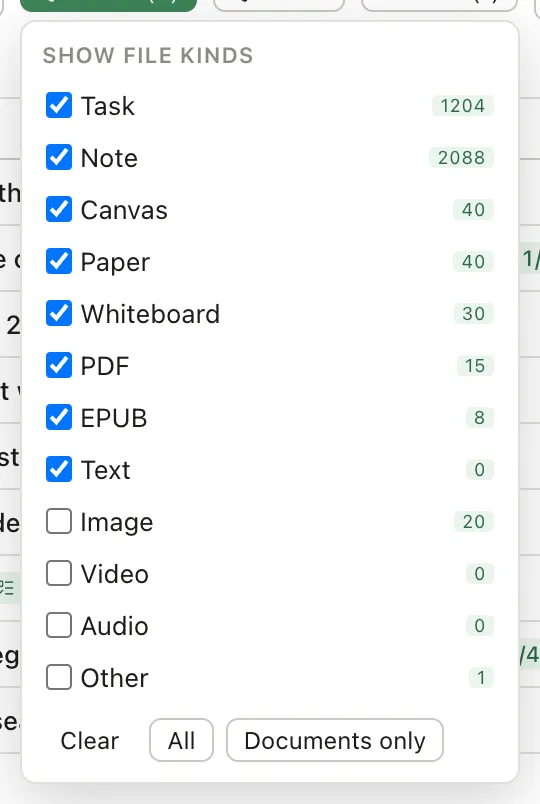
- Kinds — which kinds of file appear as rows. It sits beside Filter because it is the other thing deciding what you see.
- Filter — the condition builder.
- Sort — up to three levels; the button shows how many are in force.
- Grouping — break the table into sections.
- Hierarchy — show subtasks nested under their parents, or flatten everything.
- Timeline — slides the Timeline in beside the table.
- Columns — choose which columns show.
- Embed — copies this view as a block you can paste into a note, where it keeps itself up to date. See Embedding a table in a note.
- Import — bring in tasks from elsewhere; see Importing tasks.
- New task — opens the full task dialog.
Import and New task both create files, so both are greyed out until you enter a license key — hover either one and the tooltip says why. Everything else in the toolbar works unlicensed.


Which files show
Section titled “Which files show”Images, video, audio and unrecognised files are hidden to begin with. A vault usually holds far more pasted screenshots than notes, and a table buried under them is no use. Everything else — tasks, notes, canvases, whiteboards, Paper, PDFs, ebooks, plain text — shows by default.
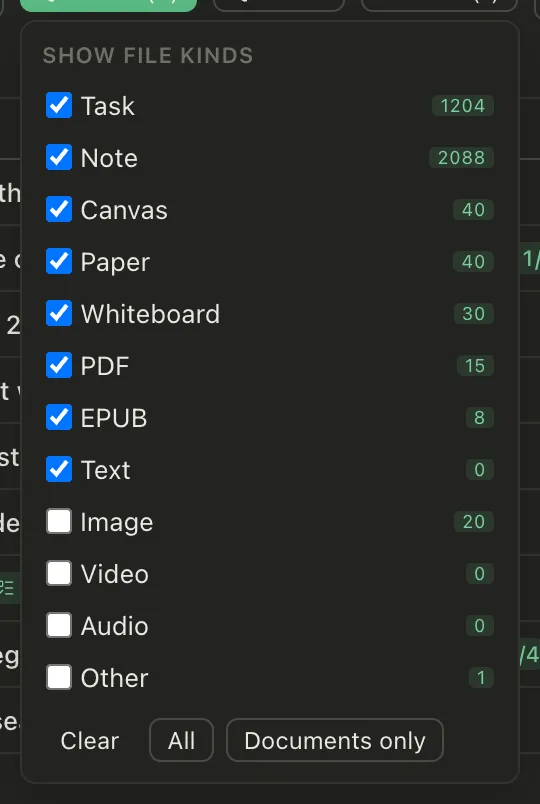
Open Kinds to change that. Each kind has a count beside it, so you can see what you’d be letting in. Three buttons at the bottom:
- Clear unticks everything. The fast way to “only PDFs” is to clear and tick one, rather than untick eleven.
- All ticks everything.
- Documents only puts the default back.
The button stays highlighted whenever some kind is hidden — including the default state, because it’s the only thing that can answer where did my screenshots go.
Clearing everything empties the table, and the table says so and offers the default back in one click.
Editing without opening anything
Section titled “Editing without opening anything”Click a status or priority cell and it cycles — Open, In Progress, Complete, Skip. Group and tag cells edit in place too.
Due and start dates are read-only in the table: they show the date but clicking one does nothing. Change a date by opening the task, or tick several rows and set a date from the selection bar. For anything more, open the task and you get the full editor with its body.
Subtasks
Section titled “Subtasks”A task can have a parent. With Hierarchy on, children sit indented under theirs, and a parent shows how far along its children are.
Turn hierarchy off when you want a flat list of everything due — a parent’s due date is often less interesting than its children’s.
Custom columns
Section titled “Custom columns”The built-in columns cover the fields every task has. Columns → Add custom column adds one for any other property in your vault — a client, an estimate, a review date. That works for any file, not just notes: a PDF can carry a Status and a Rating the same way a note can.
Start typing and it offers the properties you already use. Pick one and the column shows it, in the type that property already is. You can change that type, but the dialog warns you first: a property has one type across the whole vault, so changing it here changes it everywhere, and values that no longer fit show as invalid. Properties the table already shows, and the ones Pellet maintains for itself, aren’t offered — there’d be nothing to add.
Cells edit in place. What you type is written into the file itself where the format allows it, and kept alongside your vault where it doesn’t — see Properties.
Custom columns filter, sort and group like the built-in ones. The filter offers the values already in your vault as you type, so you don’t have to remember whether you wrote In review or in-review.
Remove column takes the column out of the table. The property and its values stay in your files.
Selecting several at once
Section titled “Selecting several at once”Tick the checkboxes and act on the lot: set a due date, change status or priority, move them to a group, delete them. Much faster than one at a time, and the usual way to clear a backlog that’s gone stale.
Very large vaults
Section titled “Very large vaults”The table only renders the rows you can see, so a vault with thousands of files scrolls at the same speed as one with twenty. Hiding a kind costs nothing either — hidden rows are never built.
The count
Section titled “The count”Top-left shows something like 2,519 of 2,984 — how many rows the current filter is showing out of everything. A useful sanity check when a filter is narrower than you meant.